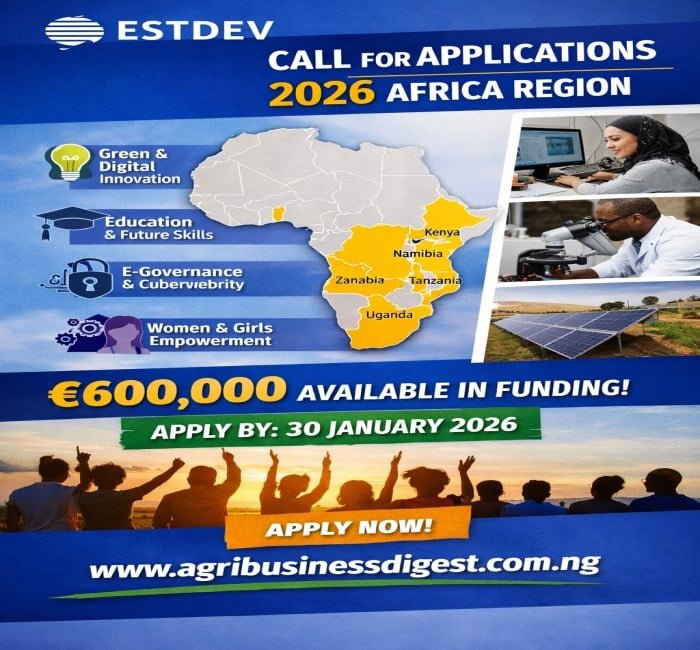
The Estonian Centre for International Development Cooperation (ESTDEV) has opened a 2026 funding application round to support development-focused projects in Botswana, Kenya, Namibia, Zambia, Tanzania, and Uganda.
This funding round targets innovative, systemic, and sustainable solutions that contribute to social and economic development through:
- Green and digital transformation (the “twin transitions”)
- Education system reform and future skills development
- E-governance and cybersecurity
- Empowerment of women and girls, particularly in technology and leadership
The programme is aligned with Estonia’s Development Cooperation and Humanitarian Aid Strategy 2024–2030 and complies with OECD Official Development Assistance (ODA) standards.
ESTDEV Objectives
This funding programme aims to:
- Support sustainable development in selected African countries
- Foster innovation ecosystems and entrepreneurship
- Strengthen education systems to meet future labour market needs
- Improve digital governance and cybersecurity
- Advance gender equality, especially for women and girls in STEM and digital sectors
- Promote cross-border and international cooperation, particularly between Estonian institutions and partner-country organisations.
ESTDEV Funding Details
- Estimated total budget: €600,000
- Application deadline: 30 January 2026
- Funding modality: Competitive grants
ESTDEV Eligibility Criteria
Eligible Applicants Typically Include:
- Non-governmental organizations (NGOs)
- Foundations and civil society organizations
- Educational and research institutions
- Public or semi-public institutions
- Innovation hubs and entrepreneurship support organizations
- Consortia involving Estonian and target-country partners
Note: All activities must clearly contribute to development outcomes in the eligible African countries.
ESTDEV Priority Themes & Supported Activities
1. Innovation Ecosystem Development
Target countries: Zambia, Uganda
This theme supports initiatives that strengthen innovation, entrepreneurship, and green–digital transformation.
Eligible activities include:
- Strengthening innovation and entrepreneurship support organisations (e.g., incubators, accelerators, university innovation centers)
- Developing sustainable and green-sector-focused business models
- Supporting startup acceleration and incubation for green and digital solutions
- Encouraging collaboration between universities, startups, public institutions, and investors
- Supporting policymaker capacity for innovation-friendly regulations
- Promoting regional and cross-border innovation partnerships
2. Future Skills & Education System Transformation
Target countries: All eligible countries
- This theme focuses on modernizing education systems to equip learners with future-ready skills.
Key areas of support:
a) Quality Teaching & Educational Leadership
- Professional development for teachers and school leaders
- Digitally enabled learning environments
- Inclusive and equitable education models
b) Curriculum & Teaching Methods Reform
- Competency-based and learner-centered education
- Digital pedagogy, creativity, and problem-solving
- Promotion of STEM/STEAM education, with emphasis on gender equity
c) Education–Labour Market Linkages
- Partnerships between schools, businesses, and communities
- Entrepreneurial learning and financial literacy
- Practical digital skills for youth employability
3. People-Centered E-Governance & Cyber-Intelligence
Target countries: All eligible countries
This priority area supports human-centric digital governance and cybersecurity resilience.
Supported activities include:
- Digital capacity building for public-sector leadership
- Change management for digital transformation
- Digital service delivery and data-driven decision-making
- Cybersecurity frameworks and skills development
- Public awareness on cyber safety and digital trust
- Strengthening public–private cooperation in IT, AI, and e-solutions
4. Inclusion & Empowerment of Women and Girls
Target countries: Kenya, Uganda
This theme aims to close gender gaps in leadership, technology, and digital innovation.
Supported activities include:
- Digital leadership development for women in senior positions
- Increasing girls’ and women’s participation in STEM fields
- Career development pathways in science, technology, and IT
- In-school and out-of-school digital skills programmes for girls
- Encouraging women’s participation in digital policymaking and innovation ecosystems
Scholarship Component (Optional Add-On)
Projects may include scholarship activities to support skills development and knowledge transfer.
Scholarship Funding
Up to €50,000 additional funding per project (on top of the main project budget)
Eligible Scholarship Activities
- Short-term training or continuing education
- Study or internship programmes
- Job shadowing, mentoring, or learning modules
- Programmes delivered:
- In Estonia
- In the target country
- Online (e-learning)
Eligible Scholarship Costs
- Tuition or training fees
- Travel and living expenses
- Visa and insurance costs
- Programme organization and mentoring (up to 5% of scholarship budget)
Key Conditions
- Scholarships must directly support project goals
- Clear learning outcomes must be defined
- Training must reflect the development needs of the target country
ESTDEV Evaluation Criteria
Applications are assessed based on:
- Relevance to Estonia’s development priorities
- Alignment with ODA principles
- Innovation and sustainability
- Expected development impact
- Feasibility and institutional capacity
- Gender and inclusion considerations
- Quality of partnerships and implementation plan
How To Apply
- Step 1: Review Official Documents
- Call for Applications (PDF)
- Evaluation methodology
- Funding Principles and Procedures
- Step 2: Develop a Strong Project Proposal
- Your proposal should clearly define:
- The development problem being addressed
- Target country and beneficiaries
- Proposed solution and activities
- Expected outcomes and impact
- Sustainability and scalability
- Partnerships (including Estonian involvement where applicable)
- Step 3: Submit Online
- Submit your application via: https://grants.kul.ee
- Login is required to access submission forms
Call for Applications 2026 Document, Africa Region
Evaluation Methodology Document
Application Deadline: 30 January 2026
Elevate Your Business With Our Expert Services!
 Business Plan/Proposal Writing Service
 Feasibility Studies
 Farm Consultation and Setup Service
 Grant Writing & Project Management
 Website Development Service
 We have the experience and proven track record. Contact us today to take your business to new heights!
 Call us @ 08034969689 or WhatsApp link https://wa.link/fw8tnw
 Visit our website @ https://agribusinessdigest.com.ng/futuregreenfarm
 Email us @ futuregreenfarm@gmail.com