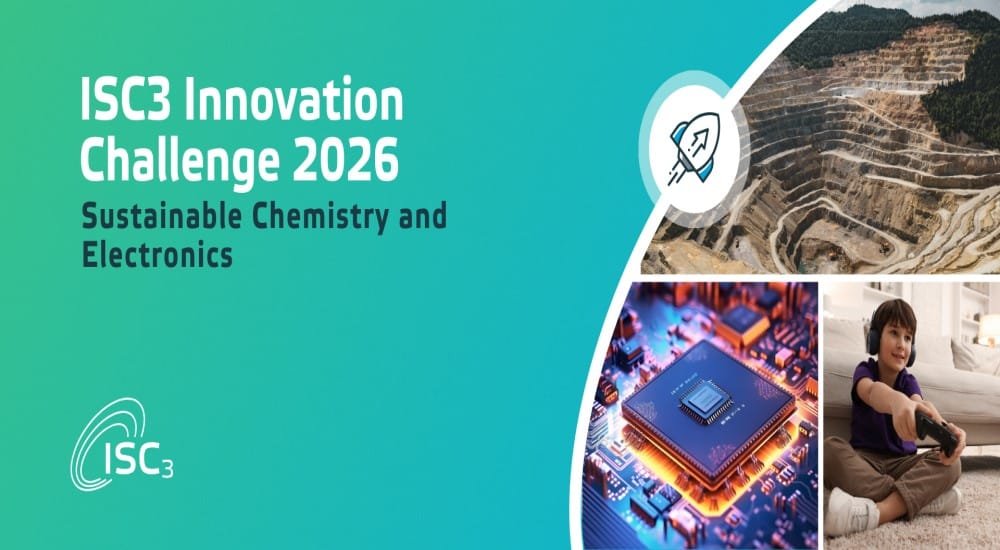
Applications are open for ISC3 Innovation Challenge 2026 – Sustainable Chemistry and Electronics. The annual ISC3 Innovation Challenge is thematically oriented along a once-per-year selected focus topic. Start-ups globally are invited to contend for a total of 25,000 EUR in prize money with their innovative ideas that are revolving around the ongoing year’s focus topic.
They are assessed by a jury of international experts who score the Start-ups and choose the finalists. The finalists’ pitches and the award ceremony take place in autumn/winter.
The winners are awarded money prizes in two categories:
- Two Special Impact Awards for Start-ups that have a noteworthy impact on the environment and society.
- The overall Winner of our Innovation Challenge.
All the finalists receive a customized support of the ISC3 Global Start-up Service in form of pitch trainings and have the possibility to be featured as Start-up of the Month.
ISC3 Innovation Challenge Focus Areas
This ISC3 Innovation Challenge 2026 is calling for chemistry or chemical technology-based innovations in the field of electronics, featuring the following subtopics:
Innovation in Design & Performance:
- Applying Eco-design principles: designing electronics for durability, repairability, recyclability, and modularity with focus on chemical and materials innovation
- Design for disassembly: using adhesives, coatings, and encapsulants that can be safely removed or chemically dissolved
- Reducing material intensity while maintaining performance
- Developing more sustainable solders, recyclable encapsulants, and solvent systems for safer assembly/disassembly
Innovations providing more resource efficient use or substitution of critical raw materials and toxic metal species:
- Alternative technologies for scarce and critical elements and critical nonrenewable resources (see Annex I a.) for details)
- Use of abundant, non-toxic, recycled / recyclable feedstocks
Sustainable Manufacturing Approaches:
- Low-energy, low-waste fabrication methods (solution processing, additive manufacturing, green solvents)
- Designing scalable, safer chemical routes generating less waste
- Sustainable alternatives to hazardous reagents and byproducts (including additional technologies) (see Annex I b.) for details)
- Development of biodegradable electronic components using polymers and organic materials
- Addressing social issues including child labor, unsafe working conditions, and other forms of injustice
End-of-Life & Circularity:
- Chemical methods for disassembly, selective separation, and recycling
- E-waste recycling and recovery of valuable materials
- Electrochemical recycling of materials in electronics (e-waste recovery of metals like Li, Co, Au)
- Mechanical or chemical recycling of plastic materials in electronics
- Use of recyclable, biodegradable materials or materials that undergo full mineralization at end of life
- E.g. biomaterials based, biodegradable conductors and semiconductors
- Closed-loop systems
- Prevention of material dissipation
Alternative & Emerging Materials:
- Organic and polymer electronics
- Advanced Materials for Electronics
- 2D materials like graphene, MoS₂, and MXenes: Surface chemistry affects electronic and mechanical properties
- Metal–organic frameworks (MOFs) and covalent-organic frameworks (COFs): Used in sensing, energy storage, and optoelectronic devices
- Self-healing or stimuli-responsive materials for flexible electronics
- Sustainable alternatives to fossil-based plastic materials used in electronics, e.g.:
- PVC for cables, insulation, flexible parts
- ABS for casings for computers, printers, TV’s, keyboards, etc.
- PS for insulation
- PC for optical discs, lenses, protective covers, LED
Novel devices:
- More sustainable Energy Storage & Conversion Devices (Batteries, Supercapacitors, Fuel Cells)
- Organic Electronics, Photonics & Optoelectronics(OLEDs, OPVs, Perovskite solar cells, Photocatalytic devices)
Benefits
Finalists will receive:
- Tailored support: access to Global Start-up Service Customised Support
- Visibility: promotion of your innovation via ISC3 communication channels
- Networking: participation in the Investor Forum 2026
- Training: individual and group pitch training for preparation of your Investor Forum 2026 pitch
- Cash prizes: the overall Innovation Challenge Winner will receive a cash prize of 15,000 EUR. The two separate categories “Best Social Impact” and “Best Regional Impact” OR “Special Impact” are endowed with cash prizes amounting to 5,000 EUR each.
Eligibility Criteria for ISC3 Innovation Challenge
- Eligible are all innovators and entrepreneurs, i.e., persons owning or representing the proposed innovation, employed by organisations including research institutes, start-ups, small-medium sized enterprises, or comparable institutions active in the development and realisation of sustainable chemistry solutions.
- Enterprises participating in the challenge shall have a staff headcount not exceeding 50 (full time equivalent) and an annual turnover of max. 10 million Euro.
- Enterprises majority-owned by large enterprises are not eligible for the award, except for innovations leading to the creation of independent spin-offs.Proposals submitted by innovators and entrepreneurs from developing countries and tackling challenges in developing countries are considered as particularly important.
- Female entrepreneurs are specifically encouraged to submit a proposal.
Assessment Criteria:
The proposals will be assessed against the three main criteria:
- Innovation level. Is the innovation unique, distinct, and truly original?
- Business viability. What is the market potential of the innovation? Is the idea commercially feasible?
- Sustainability. What is the sustainability impact of the innovation?
ISC3 Innovation Challenge Program Timeline
- Launch of the 2026 Innovation Challenge: Dezember 12th, 2025, 3:00 p.m. CET
- Deadline for proposal submission: May 4th, 2026, 0:00 a.m. CET
- Jury Evaluation: May 6th, 0:00 a.m. CEST – June 16th, 2026, 0:00 a.m. CEST
- Finalist announcements: End of June, 2026
- Finalist pitch training: July-September 2026
How To Apply for ISC3 Innovation Challenge
Application Deadline: May 4th, 2026, 0:00 a.m. CET
Elevate Your Business With Our Expert Services!
 Business Plan/Proposal Writing Service
 Feasibility Studies
 Farm Consultation and Setup Service
 Grant Writing & Project Management
 Website Development Service
 We have the experience and proven track record. Contact us today to take your business to new heights!
 Call us @ 08034969689 or WhatsApp link https://wa.link/fw8tnw
 Visit our website @ https://agribusinessdigest.com.ng/futuregreenfarm
 Email us @ futuregreenfarm@gmail.com