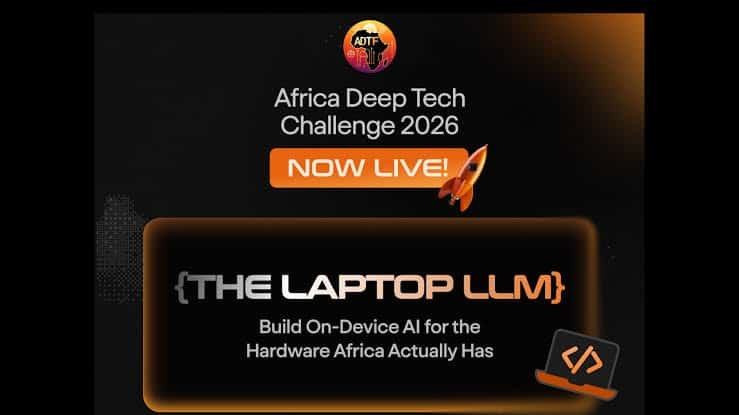
Applications are open for Africa Deep Tech Challenge 2026 – The Laptop LLM Challenge. Africa Deep Tech Challenge 2026 – The Laptop LLM Challenge is an innovation competition designed to support early-stage teams building artificial intelligence solutions that can run efficiently on everyday laptops and other resource-constrained devices.
Africa Deep Tech Challenge 2026 (inspired by the Africa AI XPrize) is an engineering-first competition to make useful language-model applications run well on the computers Africans already own: mid- and low-end commodity laptops. We are not building for exotic edge silicon. We are building for the 8 GB laptop with integrated graphics – the machine sitting on millions of desks, in classrooms, clinics, and corner shops across the continent.
Many AI solutions require expensive hardware and constant internet connectivity. The Africa Deep Tech Challenge encourages innovators to develop efficient AI systems that can operate on affordable devices, making advanced technology more accessible across Africa.
By focusing on offline AI and resource-efficient computing, the competition aims to foster innovations that address real-world challenges in sectors such as education, healthcare, agriculture, and financial services.
Africa Deep Tech Challenge Prizes
- $16,500+ in prizes
- + other prizes
- Grand Prize
- $8,000 in cash
- 1 winner
- Second Place
- $4,000 in cash
- 1 winner
- 3rd Place
- $3,000 in cash
- 1 winner
- Best African Use Case
- $1,500 in cash
- 1 winner
- Finalist Stipends
- 10 winners
- $250 (In GPU Credits) for up to 10 finalists
- Semifinalist Stipends
- 20 winners
- $50 (In GPU Credits) for up to 20 semi finalists
Eligibility Criteria
The challenge is open to:
- Emerging innovators
- Early-stage startup teams
- AI developers
- Software engineers
- Technologists
- Designers
- Creators
- Researchers
- Problem-solvers building solutions for African markets.
Requirements for Africa Deep Tech Challenge
Participants build a working, end-to-end, on-device Language Model that runs without cloud dependencies on the ADTC Standard Laptop (defined below). The model must address one of the published problem domains
Each team selects one primary domain. These are the ADTC standardized benchmarking domains; validation sets are provided for each.
- Math & Scientific Reasoning – problem solving, proof assistance, scientific question-answering, and quantitative reasoning tasks.
- Healthcare & Medical – clinical information, medical Q&A, triage support, and patient education.
- Agriculture – crop, livestock, weather, and market advisory for farmers and extension officers.
- Creative Writing – story generation, editing assistance, poetry, and narrative support across languages.
- Coding Assistants – code generation, debugging help, and programming tutoring across common languages.
- Corporate / Enterprise – knowledge-work productivity: summarization, drafting, and analysis for small and medium enterprises.
- Autonomous AI Agents – local orchestration, task automation, and privacy-focused workflow management using decentralized tools and messaging interfaces.
Judging Criteria
- Model Accuracy & Quality
A combination of multiple-choice benchmarks and qualitative evaluations that includes accuracy of prompts, quality of documentation - Model Throughput Performance
Evaluated relative to the maximum observed tokens per second - Model Efficiency
Rewards lower RAM utilization profiles relative to the maximum memory budget - African Use Case Bonus
Up to 10 extra points awarded for how applicable the model is to a real African use case - Hardware & Thermal Penalties
10 points deducted if core/package temperature exceeds 85∘C or if thermal throttling is flagged. OOM or sandbox execution crash results in disqualification
How To Apply for Africa Deep Tech Challenge
Application Deadline: August 24, 2026 @ 11:45pm
Elevate Your Business With Our Expert Services!
 Business Plan/Proposal Writing Service
 Feasibility Studies
 Farm Consultation and Setup Service
 Website Development Service
 We have the experience and proven track record. Contact us today to take your business to new heights!
 Call us @ 08034969689 or WhatsApp link https://wa.link/fw8tnw
 Visit our website @ https://agribusinessdigest.com.ng/futuregreenfarm
 Email us @ futuregreenfarm@gmail.com