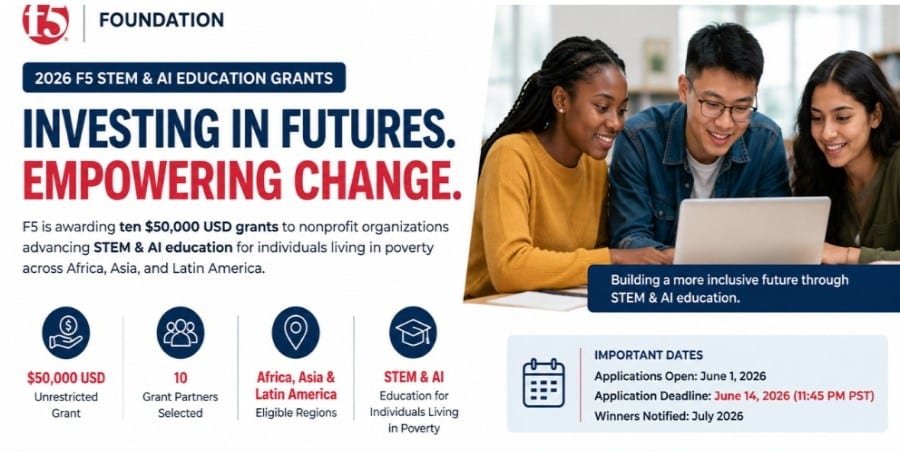
Applications are open for F5 STEM & AI Education Grants 2026. The 2026 F5 STEM & AI Education Grants focus on empowering nonprofit organizations dedicated to advancing future leaders and changemakers in underserved communities. These grants specifically target efforts in STEM & AI education within the geographical regions of Africa, Asia, and Latin America, aiming to increase access, drive innovation, and create career opportunities for those living in poverty.
F5 STEM & AI Education Grants Benefits
- Grant Amount: Each grant is a $50,000 USD unrestricted, one-time award.
- Number of Recipients: Ten grant partners will be selected for funding.
- Selection Process: Grant partners will be chosen by a global committee of F5 employees.
What’s New in 2026:
Following six successful years of offering STEM Education Grants globally, F5 is thrilled to introduce three new components for the 2026 grants that will enhance the impact of this program.
- Geographically Focused Approach:
For 2026, our grants will prioritize regions with the greatest need in STEM & AI Education resources, including:- Africa (encompassing Northern and Sub-Saharan Africa)
- Asia (including Central Asia, Eastern Asia, South-Eastern Asia, Southern Asia, and Western Asia, often referred to as the Middle East)
- Latin America (including Central America, South America, and the Caribbean)
- Artificial Intelligence (AI) Requirement:
Building on the growing influence of artificial intelligence in STEM education, we have made AI a required element for grant eligibility in 2026. Organizations applying must now explicitly incorporate AI into their programs, curriculum, and/or training initiatives. By fostering AI literacy, utilizing AI tools, and preparing participants to succeed in AI-driven industries, applicants will align with F5’s focus on driving innovation within STEM for those living in poverty. - Focus on Serving Individuals Living in Poverty:
In 2026, F5 will prioritize grants for organizations dedicated to supporting individuals living in poverty (defined by the United Nations as those living on less than US $2 per day), ensuring equitable access to STEM & AI education. By directing resources to programs that cater to underserved communities, F5 aims to break down barriers for those most in need, enhance educational opportunities, and fuel career development in STEM and AI-related fields.
These strategic evolutions reflect F5’s deep commitment to addressing inequities in STEM education, cultivating innovation in AI, and empowering those living in poverty worldwide. By concentrating efforts on underserved regions and emphasizing AI as a transformative tool, we aim to deliver targeted support that creates meaningful and lasting impact.
Eligibility Criteria for F5 STEM & AI Education Grants
- The nonprofit organization must be a legally registered charitable organization as defined by the country in which they operate and/or are registered or be fiscally sponsored by a legally registered charitable organization, with at least 3 years of operational experience.
- The nonprofit’s primary mission is to enhance access, build capacity, support career development, or conduct related initiatives to improve the inclusion of individuals living in poverty in STEM & AI education.
- Nonprofits must have a proven track record of successfully increasing access to STEM & AI education or building capacity in STEM for those living in poverty. Additionally, they must be able to provide supporting quantitative data that demonstrates their impact.
- Grant funding must primarily benefit (>50%) those living in poverty.
- Organizations must have an operational website at the time of submitting their application.
- Nonprofits based outside the United States will undergo an Enhanced Expenditure Responsibility (EER) process, facilitated by F5’s international grantmaking partner, CAF America. Approval of the EER process is required for funding eligibility, and F5 will cover all EER fees.
- Organizations with written policies that discriminate based on race, color, age, sex (including pregnancy or transgender status), marital or familial status, sexual orientation, gender identity or expression, political ideology, creed, religion, ancestry, ethnicity or national origin, military or veteran status, sensory, mental or physical disability, genetic information, or any other classification protected by applicable local, state, or federal laws are ineligible for this grant.
- Nonprofits must allocate funding exclusively to programs serving those living in poverty in any of the following regions:
- Africa (encompassing Northern and Sub-Saharan Africa)
- Asia (including Central Asia, Eastern Asia, South-Eastern Asia, Southern Asia, and Western Asia, often referred to as the Middle East)
- Latin America (including Central America, South America, and the Caribbean)
Quantitative Demonstration of Impact
To strengthen your grant application, nonprofits must provide quantitative details showcasing how your organization has successfully increased access to or built capacity in STEM & AI education for those living in poverty. Examples of strong quantitative evidence include:
- College Placement Rates: Showcase the percentage of participants who were successfully placed into college, particularly in STEM-related fields.
- Graduation Rates: Provide data on the number or percentage of program participants who have graduated from STEM education programs or other related initiatives.
- Employment Rates: Share statistics on the rate at which participants secure jobs or internships in STEM sectors.
- Improved Comprehension or Academic Scores: Highlight measurable improvements in STEM-related comprehension or test scores among program participants.
- Program Completion Rates: Demonstrate the percentage of individuals who successfully complete your organization’s initiatives or training programs.
- Increased Representation Metrics: Provide detailed statistical evidence demonstrating growth in the inclusion of individuals living in poverty across your programs, STEM-related careers, or educational pathways. Highlight specific efforts that enhance access, strengthen capacity, foster career development, or implement initiatives aimed at advancing their representation in STEM & AI education.
Quantitative data is a crucial and required component in demonstrating your success and ensuring alignment with F5’s goals for empowering those living in poverty in STEM & AI education and technology sectors.
How To Apply for F5 STEM & AI Education Grants
- All grant applications must be submitted electronically.
- The application cannot be saved and returned to later, so applicants are strongly encouraged to review the application questions beforehand.
- The total character count for the application is capped at 200,000 characters, with a maximum of 4,000 words per response. The application must be completed in English.
Application Deadline: June 14, 2026, closing at 11:45 PM PST.
Elevate Your Business With Our Expert Services!
 Business Plan/Proposal Writing Service
 Feasibility Studies
 Farm Consultation and Setup Service
 Grant Writing & Project Management
 Website Development Service
 We have the experience and proven track record. Contact us today to take your business to new heights!
 Call us @ 08034969689 or WhatsApp link https://wa.link/fw8tnw
 Visit our website @ https://agribusinessdigest.com.ng/futuregreenfarm
 Email us @ futuregreenfarm@gmail.com